Introduction: The Future of CRM Is Here
Customer relationship management (CRM) is evolving rapidly. Businesses are no longer looking for software that simply stores customer details and tracks sales. They need smarter tools that help them understand customers, automate everyday tasks, improve team productivity, and deliver better experiences at every stage of the customer journey.
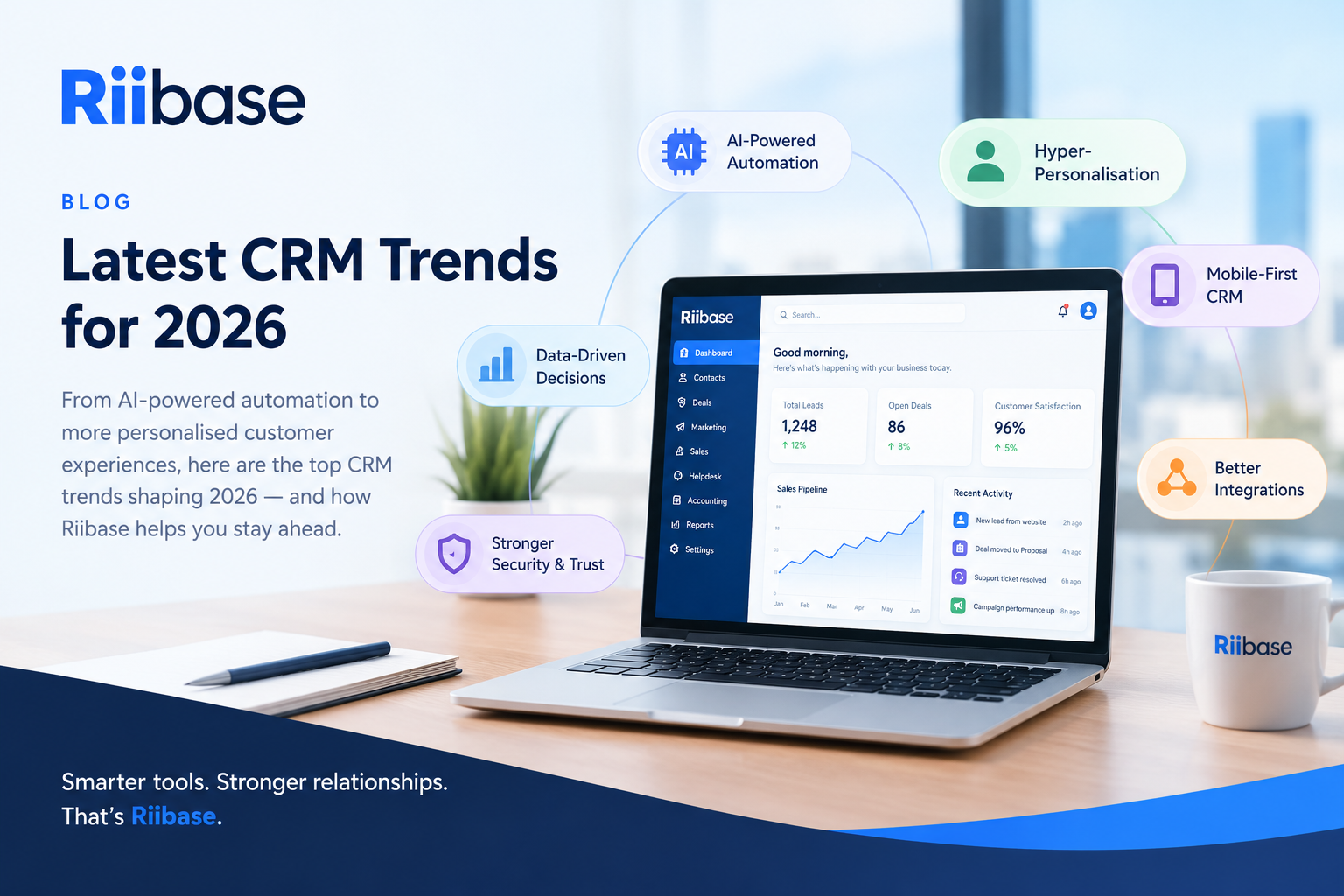
In 2026, CRM software is becoming more intelligent, connected, and customer-focused. Artificial intelligence (AI), workflow automation, personalised communication, real-time analytics, and integrated business tools are changing how companies attract leads, manage opportunities, and build long-term customer relationships.
According to industry analysis published in 2026, CRM platforms are increasingly evolving from systems that record customer information into platforms that help teams make decisions and execute customer-related workflows. Data quality, responsible AI adoption, and measurable business outcomes are also becoming important priorities.
For small businesses, startups, and growing organisations, these changes create an opportunity to compete more effectively without adding unnecessary complexity to their operations.
This is where Riibase CRM comes in. Riibase aims to help businesses simplify customer management and bring essential business workflows together through a modern CRM platform.
Let's explore the latest CRM trends for 2026 and how your business can prepare for the future.
1. AI-Powered CRM Is Becoming More Important
Artificial intelligence is one of the biggest developments shaping CRM software in 2026.
Traditional CRM systems rely heavily on employees to enter information, update records, review reports, and decide which leads to contact. AI-powered CRM capabilities can assist with many of these tasks, helping teams spend less time on administration and more time building relationships.
Some emerging AI applications in CRM include:
- Lead prioritisation: Identifying promising prospects based on available customer and sales data.
- Automated communication assistance: Helping teams draft personalised emails and follow-ups.
- Sales forecasting: Analysing historical performance and pipeline information to support better planning.
- Customer insights: Highlighting patterns in customer behaviour and engagement.
- Intelligent recommendations: Suggesting potential next steps based on customer activity and business rules.
AI adoption should not be about adding technology simply because it is popular. Businesses should focus on practical applications that solve real problems and deliver measurable value.
With Riibase, businesses can establish a central place for managing customer information and sales activities. As you evaluate CRM capabilities, look for opportunities to streamline workflows and use customer data more effectively, while ensuring any AI features you adopt are accurate, secure, and appropriate for your business.
Business takeaway: Start with one repetitive task, measure how much time it consumes, and investigate whether automation or AI assistance can reduce that workload.
2. CRM Automation Is Moving Beyond Simple Reminders
Automation has become an essential consideration when choosing CRM software.
Sales and customer-facing teams frequently repeat the same activities: assigning leads, sending follow-up emails, updating deal stages, scheduling reminders, and notifying colleagues about important changes.
When these processes are handled manually, opportunities can be missed and employees spend valuable time on administrative work.
In 2026, businesses are increasingly looking for CRM automation that connects multiple steps into a complete workflow.
For example, a business might create a process in which:
- A prospective customer submits a website enquiry.
- The enquiry is recorded in the CRM.
- The lead is assigned to the appropriate team member.
- A follow-up task is created.
- The salesperson receives a notification.
- The team tracks the opportunity through the sales pipeline.
Similar workflows can support customer onboarding, marketing campaigns, support requests, and renewal reminders.
The objective is simple: make sure important activities happen consistently without relying on employees to remember every step.
Riibase can serve as the central platform for organising customer records and business activities. Businesses should explore the workflow and automation capabilities available in their chosen plan and prioritise processes that reduce delays and improve accountability.
Business takeaway: Map your current sales process and identify three repetitive tasks that could be standardised or automated.
3. Personalised Customer Experiences Are Becoming the Standard
Customers increasingly expect businesses to understand their needs and communicate with them in a relevant way.
Generic messages, repeated questions, and irrelevant offers can make a business appear disconnected from its customers. Personalisation helps companies deliver more useful interactions by considering customer preferences, previous conversations, interests, and purchase history.
Modern CRM software makes it easier to organise this information and use it to guide customer engagement.
Examples of CRM-driven personalisation include:
- Sending different communications to new leads and existing customers.
- Tailoring offers to customer interests or previous purchases.
- Reminding sales representatives about previous conversations.
- Identifying customers who may need additional assistance.
- Creating relevant follow-up campaigns based on customer activity.
However, personalisation depends on the quality of the information a business collects. Incomplete or outdated records can lead to poor recommendations and inappropriate communication.
Riibase can help businesses organise customer information in one place, providing a foundation for more consistent and relevant interactions. When combined with well-planned marketing and sales processes, a structured CRM approach helps teams move beyond generic communication.
Business takeaway: Segment your contacts into meaningful groups and make your next campaign more relevant to each group's needs.
4. Unified Customer Data Is Replacing Disconnected Systems
One of the most important CRM trends in 2026 is the growing emphasis on connected customer information.
Many businesses use separate tools for sales, marketing, accounting, customer support, and online transactions. While each application may serve a useful purpose, switching between systems can create fragmented information and unnecessary manual work.
Consider a salesperson who cannot see a customer's latest support issue, or a marketing team that sends an offer to someone who has already purchased the product.
These problems often occur when customer information is spread across disconnected platforms.
A modern CRM strategy aims to create a more complete view of the customer by improving how information is organised, accessed, and shared.
Benefits can include:
- Better visibility into the customer journey.
- Fewer duplicate records and conflicting details.
- Improved coordination between departments.
- More relevant sales and marketing activities.
- Better reporting and decision-making.
Riibase is designed to support businesses looking to simplify customer management through a modern CRM approach. When assessing Riibase or any other CRM provider, consider which business functions can be managed in one platform and which external integrations are available for your requirements.
The goal is not necessarily to eliminate every existing tool. It is to reduce unnecessary fragmentation and make essential customer information easier to access.
Business takeaway: Identify where your customer data currently lives and determine which information your sales, marketing, and support teams need to share.
5. Data-Driven Decisions Are Becoming Essential for Sales Teams
Successful sales teams need more than a list of contacts. They need to understand what is happening across their pipeline, which activities produce results, and where opportunities are getting stuck.
CRM analytics help turn everyday business activity into information that managers can use to make better decisions.
In 2026, businesses are placing greater emphasis on actionable insights rather than simply collecting large amounts of data.
Useful CRM metrics include:
- Number of new leads generated.
- Lead-to-customer conversion rate.
- Average time taken to close a deal.
- Sales pipeline value.
- Revenue generated by different channels.
- Follow-up completion rates.
- Customer retention and repeat purchases.
For example, if a business generates many leads but converts only a small percentage into customers, the problem may involve lead quality, slow follow-ups, pricing, or the sales process itself.
A CRM helps teams investigate these patterns and make informed adjustments.
Riibase can provide a central environment for organising customer and sales information. Businesses should use the reporting capabilities available to them to monitor performance, identify bottlenecks, and establish clear goals for improvement.
Remember that collecting more data does not automatically lead to better decisions. The most useful metrics are those that help answer specific business questions.
Business takeaway: Choose five meaningful sales metrics and review them regularly rather than relying solely on overall revenue figures.
6. Mobile-First CRM Is Supporting Flexible Teams
Business is no longer confined to an office. Sales representatives meet customers on-site, service teams travel between appointments, and business owners manage operations from different locations.
As a result, mobile accessibility remains an important consideration when choosing CRM software.
A mobile-friendly CRM experience allows employees to access customer information, review opportunities, record meeting notes, and update activities while working away from their desks.
Depending on the platform and available functionality, mobile CRM workflows can help teams:
- Retrieve customer details before a meeting.
- Record important conversations immediately.
- Update deal progress after a customer interaction.
- Review upcoming tasks and appointments.
- Reduce delays in entering information into the system.
The value of mobile CRM is not simply having a smaller version of a desktop interface. It is enabling employees to complete important tasks quickly and securely wherever their work takes them.
When evaluating Riibase, check its current mobile experience, supported devices, and browser compatibility against your team's needs.
Business takeaway: Make sure your CRM fits the way your team actually works, whether that means an office computer, a laptop, or a mobile device.
7. Omnichannel Customer Engagement Is Becoming More Connected
Customers may discover a business through a website, respond to an email, ask a question through social media, or contact a support team before making a purchase.
They expect these interactions to feel connected rather than like separate conversations with different organisations.
Omnichannel CRM strategies aim to improve continuity across the customer journey by bringing relevant interactions and information together.
For example, a prospect might submit a website enquiry, receive a sales follow-up, ask a technical question, and eventually become a paying customer. When the relevant information is accessible to the right employees, the business can respond more effectively.
Key considerations include:
- Keeping customer records consistent.
- Recording interactions where supported.
- Connecting relevant communication channels.
- Making customer handovers easier between teams.
- Respecting communication preferences and consent.
A CRM should help teams maintain context rather than force customers to explain their situation repeatedly.
Riibase can be part of this strategy by helping businesses organise their customer relationships and related activities. Before adopting a CRM, confirm which communication channels and third-party integrations it supports.
Business takeaway: Review the channels customers use to contact you and identify where conversations are being lost or repeated.
8. CRM Security, Privacy, and Data Governance Matter More Than Ever
As businesses collect more customer information and adopt AI-powered tools, protecting that information becomes increasingly important.
Customer databases can contain names, contact details, commercial information, purchase histories, and other sensitive business data. Poor access controls or inadequate data practices can undermine customer trust and expose an organisation to risk.
In 2026, businesses should evaluate CRM security and privacy alongside usability and pricing.
Important considerations include:
- Role-based access controls.
- Secure authentication and account management.
- Data backup and recovery arrangements.
- Clear data retention and deletion procedures.
- Appropriate handling of customer consent.
- Transparency about how customer information is processed.
- Relevant privacy and regulatory requirements.
Businesses should also review how third-party integrations and AI services access or process CRM data.
Riibase users should review the platform's current security, privacy, and access-control documentation to understand the protections and controls available to them. Every business should also establish appropriate internal policies for handling customer information.
A CRM provider should be evaluated not only on the features it offers but also on how well its documented controls meet your organisation's requirements.
Business takeaway: Review who can access your customer data, what information they can see, and how your business protects that information.
9. CRM Consolidation Is Helping Businesses Reduce Complexity
Many growing businesses gradually accumulate software subscriptions as their requirements evolve. They might use one platform for customer management, another for email marketing, a separate tool for support, and additional applications for sales reporting.
Over time, this fragmented setup can become difficult to maintain.
Employees may need to learn multiple interfaces, data may be duplicated, and managers may struggle to obtain a complete picture of business performance.
This is why CRM consolidation is an important consideration for 2026.
Instead of adding another standalone tool for every new requirement, businesses are reviewing whether a more connected software platform can simplify their operations.
Potential advantages include:
- Fewer manual data transfers.
- More consistent customer information.
- Simpler employee training.
- Better visibility across business activities.
- Easier coordination between teams.
Riibase aims to give businesses a streamlined approach to customer relationship management. For organisations that want to simplify their software stack, it is worth assessing how Riibase fits alongside their existing sales, marketing, support, accounting, and commerce tools.
Consolidation should be based on actual business needs rather than the number of features advertised by a provider. Some specialist tools may still be necessary, particularly where advanced functionality or industry-specific compliance is required.
Business takeaway: Audit your software subscriptions and look for overlapping functionality, unnecessary complexity, and opportunities to connect your systems.
10. CRM Adoption and Ease of Use Are Critical to Success
Even a feature-rich CRM can fail to deliver value if employees find it difficult to use.
Complicated interfaces, excessive data-entry requirements, and poorly designed processes can discourage teams from keeping records up to date. When employees work around the CRM instead of using it, the quality of customer data and reporting suffers.
Businesses are therefore placing greater importance on usability, onboarding, and practical adoption.
A successful CRM implementation should make everyday work easier. Employees should understand how to enter customer details, update opportunities, schedule follow-ups, and access the information they need.
When evaluating a CRM provider such as Riibase, consider:
- How quickly employees can learn the platform.
- Whether the interface fits your sales process.
- How easily customer records can be maintained.
- Whether the available training and support meet your needs.
- How well the platform accommodates your business as it grows.
It is also important to involve employees in the selection process. Their feedback can reveal workflow problems that management might otherwise overlook.
Business takeaway: Start with a small group of users, establish a straightforward process, and measure adoption before expanding CRM usage across the organisation.
How to Choose the Right CRM Software in 2026
With so many CRM platforms available, selecting the right one can be challenging. The best solution is not necessarily the most expensive or the one with the longest feature list. It is the one that fits your business requirements and helps your team work more effectively.
Before choosing a CRM, consider the following questions:
1. Does it fit your business size?
Choose a solution that meets your current needs without introducing unnecessary complexity.
2. Can it support your sales process?
Look for ways to organise leads, track opportunities, manage customer records, and monitor follow-ups.
3. Can it reduce manual work?
Evaluate the automation capabilities available for your most repetitive activities.
4. Does it provide useful reporting?
Ensure you can monitor the metrics that matter to your business.
5. Does it work with your existing tools?
Check integrations, data import options, and compatibility with your current software.
6. Is the pricing sustainable?
Review subscription costs, user limits, plan restrictions, and any additional charges.
7. Can your team adopt it easily?
Prioritise usability, onboarding, support, and a clear implementation plan.
8. Does it meet your security requirements?
Review documented security measures, privacy terms, access controls, and data-handling practices.
For startups and small businesses, affordability and ease of implementation can be particularly important. Growing organisations should also consider scalability, integrations, and the ability to adapt workflows as their operations become more complex.
Why Consider Riibase CRM in 2026?
The latest CRM trends point towards a common goal: helping businesses build stronger customer relationships while reducing the effort required to manage everyday operations.
Riibase is a CRM provider for businesses looking for a modern approach to customer management. Rather than allowing customer information and sales activities to become scattered across spreadsheets and disconnected systems, businesses can use a CRM to establish more structured processes.
With Riibase, businesses can explore a more organised approach to:
- Customer management: Keep customer information organised and accessible.
- Lead management: Structure the process of capturing and following up with prospective customers.
- Sales pipeline management: Track opportunities and understand where deals stand.
- Workflow efficiency: Identify repetitive activities that can be streamlined using available tools.
- Business visibility: Use organised customer and sales information to support better decisions.
- Business growth: Establish consistent processes that can evolve as the organisation expands.
The right CRM should do more than store contact details. It should help your team stay organised, respond to opportunities, and build better relationships over time.
Riibase is worth considering if you are reviewing your current CRM, moving away from spreadsheets, or looking for a more structured way to manage customer relationships.
Explore the platform to see how it fits your specific workflows, team requirements, and budget.
The Future of CRM: What Should Businesses Do Next?
The most important CRM trends for 2026 are not isolated technological developments. AI, automation, personalisation, analytics, mobile accessibility, and connected customer data all contribute to a broader shift towards more efficient and customer-focused business operations.
However, businesses do not need to adopt every new technology immediately.
A practical approach is to begin with the problems that affect your customers and employees most. Improve the quality of your customer records, establish a consistent sales process, automate repetitive tasks where appropriate, and track the results.
Once these foundations are in place, your business will be better positioned to benefit from more advanced CRM capabilities.
Riibase can be part of that journey by providing a platform for organising customer relationships and building more structured business workflows.
The future of CRM is not simply about collecting more customer data. It is about using information more effectively to create better experiences and stronger business relationships.
Conclusion
CRM software is becoming an increasingly important part of how businesses operate in 2026. From AI-assisted workflows and smarter automation to personalised engagement and data-driven decisions, the latest trends offer opportunities to improve productivity and customer satisfaction.
For small businesses, startups, and growing organisations, the key is to choose a CRM that addresses real operational challenges without creating unnecessary complexity.
Riibase offers businesses a modern CRM option to explore as they look to organise customer information, manage sales activities, and improve their customer management processes.
Whether you are adopting CRM software for the first time or reviewing an existing system, now is a good time to assess your processes and identify where a better CRM strategy can make a difference.
Ready to take a more organised approach to customer relationships?
Visit www.riibase.com to explore Riibase CRM and see whether it is the right fit for your business.
Frequently Asked Questions (FAQs)
1. What are the biggest CRM trends in 2026?
The major CRM trends in 2026 include AI-assisted workflows, advanced automation, personalised customer engagement, unified customer data, actionable analytics, mobile accessibility, connected communication channels, and stronger data governance.
2. Why is CRM software important for small businesses?
CRM software helps small businesses organise customer information, track leads, manage sales opportunities, maintain follow-ups, and build consistent customer relationships. It can also help teams reduce administrative work and improve visibility into sales performance.
3. How is AI changing CRM software?
AI is helping CRM platforms support tasks such as drafting communications, summarising customer interactions, identifying patterns, prioritising leads, and assisting with forecasting. The specific capabilities available depend on the CRM provider and plan.
4. What should businesses look for in CRM software in 2026?
Businesses should consider ease of use, contact and lead management, sales pipeline visibility, automation, reporting, integrations, mobile accessibility, pricing, security, and scalability.
5. Is Riibase a CRM provider for small businesses?
Riibase is a CRM provider that businesses can evaluate for managing customer information and sales activities. Businesses should review its current features and pricing to determine whether it matches their operational requirements.
6. How can CRM automation improve sales productivity?
CRM automation can reduce repetitive administrative work, standardise follow-up processes, create reminders, assign tasks, and help sales teams maintain consistent workflows. The results depend on how well the workflows are designed and implemented.
7. Should a business replace its existing CRM in 2026?
Not necessarily. Businesses should assess their current CRM's usability, costs, reporting, integrations, and ability to support changing needs. Switching makes sense when the benefits outweigh migration costs, disruption, and retraining requirements.